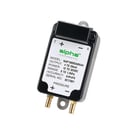

Since the end of 2012, Servoflo has been selling the mp6 micropump, made by Bartels of Germany.
This unique micropump focuses on pumping up to 7 ml/min of water and 18 ml/min of air/gas. Other liquids can also be pumped. Typical applications for the micropump include medical drug delivery, cell culturing applications, fuel cells, consumer, nebulizers and much more.
mp6 micropumpThe functional principle is based on a piezoelectric diaphragm in combination with passive check valves. A piezo ceramic mounted on a coated brass membrane is deformed when voltage is applied. By the resulting down stroke, the medium is being displaced out of the pump chamber below. The check valves on both sides of the pump chamber define the flow direction.
The response to this product has been tremendous, and we are excited about the many new possibilities for this interesting product.
Bartels has release 4 new tech notes to assist customers in their use of the pump:
Amplitude and Frequency Effects on Flow Performance - Based on the diaphragm pump principle, themp6 has a typical flow and pressure performance. By controlling the piezo actuator deflection, the performance can be varied. The amplitude determines the height of the piezo deflection and thereby the displaced volume and the frequency the number of deflections.
Running Multiple mp6 Micropumps - Applications requiring higher flow rates can be done by combining pumps together, in either series for higher backpressure situations (600 mbar for liquid) or in parallel for higher flow rate (about 7 ml/min per pump for water).
Media Compatability of the mp6-pp - The mp6-pp is a polypropylene version of the micropump. This table shows the chemical resistance of the polyproplyene for different media.
Viscosity Effects on Pump Performance - This note discusses the effect of different viscosities on pump flow and pressure performance.
In addition, there are many other application notes and demonstration videos which may be of interest.
See a listing of all application notes
Check out video demonstrations of the mp6 pump
Review technical specifications of the mp6 micropump
Selecting a pressure sensor for your application sounds simple, but with the huge amount and range of performance options, it's easy to get overwhelmed with what the best model is for your application.
We have seen situations where designers choose the most expensive and most accurate part for their needs at the beginning of the design. It's the path of least resistance. However, once production arrives and cost reduction is required, most especially for high volume applications, the established, set-in-stone design specification does not allow for a lower cost option without sacrificing performance. The engineer is stuck or needs to initiate a costly redesign.
To prevent this situation from occurring, we suggest starting with the widest tolerance (and hence lower cost) pressure sensor. Through your testing and evaluation phase, you may find that the lower tolerance models can work. In particular, if you have the ability to provide your own calibration or additional signal conditioning, you may discover that an acceptable specification is met. Furthermore and most importantly, it is significantly easier to move up the price/performance chain than going down it. Flexibility is designed in should performance requirements tighten in the future.
Once the target accuracy is determined for a product, designers should then look at sensor options in conjunction with their ability to add value (such as calibration, temperature compensation, signal conditioning). This is the classic make versus buy question which must be asked. We can help with the answer!
If you have an application for a pressure sensor and have limited resources on finding a solution, tell us your needs and let us do the work for you.
InControl Medical, located in Wisconsin, is a medial equipment company offering solutions for female urinary incontinence, a common problem among women, particularly after childbirth. At least 20% of the female population in the United States experiences this problem. Previous offerings to solve this health problem were uncomfortable, yielding poor results that often lead to invasive surgery to correct the pelvic floor.
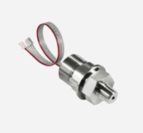
In response to this problem, InControl Medical created InTone, which combines electrical muscle stimulation and biofeedback to create a non-invasive home-use solution offering more comfort, better tracking, and thus improved results for patients. The patented probe, shown below, contains a small pressure sensor that measures the change in pressure inside the probe when the muscle contracts against it. This data is tracked in the handheld control unit that acts as a portable therapist, guiding the patient with visual and audible instructions to ensure exercises are done correctly. Precise gains in pelvic floor muscle strength are documented in one one-hundredth of a pound per square inch. Each session is date stamped and weekly averages are calculated to compare against previous weeks, thus allowing health care providers to follow the patient's progress.
About the pressure sensor
When selecting a pressure sensor, InControl turned to Servoflo to assist in finding a solution. After evaluating their application requirements, Servoflo suggested trying the SLP33A Pressure Sensor Series, a high performing gauge pressure sensor with a 0-2 psi range and a linear 0.5 to 4.5 volt output. Because the temperature range in the application is narrow, InControl is able to optimize the output resolution and accuracy to provide data to one one-hundredth of a pound per square inch. This pressure sensor also accepts a low power supply of 2.2V to 3.3V and a small size of 10 mm X 8.6 mm, making it a perfect fit for portable medical applications. The pressure sensor is available as a 6 pin dual-in-line package or surface-mount. The high performance combined with low cost made it an ideal choice for InControl Medical. Obtain detailed specifications about the SLP33A pressure sensors.
To learn more about InControl Medical, please visit their website at www.incontrolmedical.com.
To learn more about pressure sensing solutions from Servoflo, please visit www.servoflo.com. Servoflo is a provider of pressure sensors, humidity sensors, sensor signal conditioners, and LED drivers for the medical, process control, HVAC, automotive and other industrial applications.
Sorry to have been missing in action on our blog!!
We have posted a new white paper on our web site written by David Grice of ZMDI. The article, published in Sensors Magazine, is titled, "Optimizing the Calibration of Sensor Interfaces With Built-In Correction Algorithms". Here is an abstract of the article with a complete link to download.
Sensor signal conditioners with built-in correction algorithms can greatly aid sensor system designers as long as they understand which algorithm to use and when. The perennial challenge for sensor interface designers is to calibrate and correct the inherent nonidealities present in transducers. The major contributors to nonideality are typically the nonlinear response to stimulus, the offset, and the temperature dependence of one or both of these factors. The advent of commodity IC's with high-performance analog and complex digital circuitry reduces the effort and cost of sensor correction and provides the designer with systemic methodologies and tools for sensor correction. This article examines these techniques and describes how to optimize them for one broad class of sensor signal conditioners that are inexpensive yet highly configurable, enabling high-precision measurements made using a range of sensor types.
You may download the complete white paper here. No sign up necessary!
When designing a new product, looking for components can be daunting. Often times, designers must decide whether to purchase an off-the-shelf pressure sensor or design their own. This post helps clarify the criteria designers can apply when making this important decision.
- What do I need from the total SYSTEM perspective? Look at the overall product by reviewing total performance requirements, the market and applications. How does this affect component selection?
- How quickly will begin sellingyour product?
- What skills do you have within your organization? What skills do you need to outsource? For example, do you have electrical and mechanical engineering skills residing within your organization? If you do, are they accessible and available for design assistance? If you need to look elsewhere, do you have a qualified resource to utilize?
- Do you have the equipment necessary to calibrate your own transducer? Typical equipment needed are temperature, pressure and humidity tools to modify the environment for calibration. Are there people available to calibrate your designed sensor?
- There are additional logistical issues to consider. For instance, what is your annual requirement of sensors? What is your time-to-market and cost targets? Where are you manufacturing? Are there any proprietary issues to consider? How many sources do you need?
By reviewing these questions, the path to deciding between make versus buy becomes much clearer. You should buy a complete transducer if you are resource-limited and have a fast-time to market requirement. Lower volumes typically under 25,000 sensors per year do not usually warrant the investment in making your own transducer. Above this quantity, return on investment on internal resources is improved and may be something to consider.
Let's take a look at a specific example by evaluating the following situation.
An application has a requirement for a calibrated, temperature-compensated pressure sensor that measures up to 30 psi. An amplified, off the shelf solution has a cost of between $6-7 each at 1,000 pieces, with a 1.5% to 1.8% accuracy over a broad temperature range. A fully packaged solution also translates into fewer parts to buy and stock.
To create the same transducer internally, the cost of an unamplified, uncalibrated pressure sensor plus additional op amps and signal conditioning to calibrate for span and off-set would cost in parts approximately $2-3, not including assembly labor and calibration time. Perhaps your accuracy requirements are not as stringent as 1.8% over a wide temperature range or there are packaging issues to consider. Another consideration to think about, if you are utilizing a contract manufacturer, there are typically assembly charges per component so the additional insertion of perhaps 6 components could affect assembly costs.
If your volumes are very high, investment in automated, more sophisticated calibration equipment can reduce labor time and costs and have an attractive return on investment.
Our team of experts combined with a broad selection of pressure sensors (both unamplified and fully packaged) and signal conditioning parts can guide you through this process. Our huge offering ensures that a solution can be found for you, regardless if you make or buy.
To get started, the best use of your time is to take advantage of the Sensor Selection Tool. We can then provide you with informed, detailed options for your consideration at no obligation to you. We view our role as a design resource to find you an optimal solution for your design.
Access the Sensor Selector Tool here
Review our Transducer Design Guide which includes typically sensor elements and signal conditioning for making your own pressure transducer.
Sensor technology has changed dramatically over the past few years. Previously, customers purchased the sensor elements and electronics and calibrated a sensor themselves. The development of improved electronics, MEMs technology and efficient manufacturing technology has created a new humidity sensor market - fully calibrated humidity sensors with an I2C output. Many companies are offering models with similar features.
Yet, price and performance does vary significantly between models, making it important for users to understand the the performance of a humidity sensor over the entire range. This data is often well hidden in fine print in data sheets.
IST, the supplier of our HYT digital humidity elements and the new sensor elements P14, tested 4 different humidity sensors at 85% rH @ 30C for 65 hours. 2 competitors, the HYT271, and the P14 humidity element were tested. The 2 competitors units showed a 1.25% and 2.5% deviation in readings compared to only 0.17% for the HYT271 and 0.09% for the P14.
What does this mean for designers trying to choose a humidity sensor? The humidity sensor element (such as P14) plays a critical role in the performance of a fully integrated and compensated humidity sensor. Electronics is limited in compensating for poor signals a sensor element sends. The combination of good sensor elements and electronics is the key to sensor design.
The integration of a sensor element and electronics is fairly straightforward. However, if performance over time and at extreme conditions is critical for your application, take the time to research the quality and stability of the sensor element used. Saving a little in upfront component cost could end up costing you much more in the long run!
Ceramic pressure sensors typically use thick-film technology to create a low cost, stable, and robust media-compatible pressure sensor. These sensors are an excellent alternative to more expensive stainless steel pressure sensors or oil-filled sensors using silicon piezoresistive sensing elements for any application where an o-ring can be used.
Why? Ceramic pressure sensors are capable for use in nearly all types of harsh media and high pressures. They can be easily packaged to meet your own housing requirements, and many configurations are available including unamplified or signal-conditioned, various calibration ranges. Low cost, single piece (monolithic) sensors come as gauge only. A smooth membrane is welded to the base to allow for absolute and sealed gauge snesors when that configuration may be required. Also available are ceramic capacitive sensors which have the abilility to measure low pressures such as 60 mbar but can tolerate high overpressures. For example, the ME550 can tolerate an overpressure of 2 bar. This advantage offers designers new possibilities for pressure measurement.
As we previously said, using a ceramic pressure sensor requires the use of an o-ring which is straightforward and inexpensive. Standard models have 96% ceramic composition which takes care of many types of harsh media. For certain types of media, 99% ceramic composition can also be requested. For the ultimate protection, saphire composition is also available. However, since it is expensive, it is important to understand the nature of your media.
Ceramic pressure sensors can be used in all types of applications including
- Gasoline measurement
- Hydraulic and brake fluid
- Wafer processing
- High pressure pneumatic control
- Level measurement
- Medical applications and much more
Packaging these sensors can be customized for your application or through use of standard housing which is also available. See the image here which shows standard housing. The sensor can be easily embedded in vales and pumps, opening the possibilities for better control in your application.
Check out our ceramic pressure sensors
We recently read a press release by a research company discussing pressure sensors and MEMS. We found the article to be very interesting and thought we would share some key points:
- Pressure sensors generated $1.22 billion in revenue mostly driven by a strong automotive industry recovery, up 26% from 2009.
- By 2014, revenue for MEMS pressure sensors will be $1.85 billion.
- Automotive sector remains the largest area for MEMS pressure sensors at 72%, followed by medical electronics at 11%. The remaining area is general industrial and consumer electronics.
Automotive applications primarily reside in manifold air pressure sensors and a growing area in transmission systems. The most popular medical application involves low cost disposable devices for catheters used during surgical procedures, with additional growth in CPAC (continuous positive airway pressure) for sleep apnea.
Industrial applications are primarily in the HVAC sector, level measurements, and various industrial process and control applications. Consumer applications include weather stations, sports watches, bike computers, dive equipment, pedometer and white goods.
As a provider of MEMS pressure sensors that can work for all of the above mentioned applications, we were, of course, pleased to see forecasted growth. We have seen pressure sensor designs make tremendous gains in performance, calibration ranges, and reduced size. Product designers have a wide range of pressure sensors to choose from.
We are curious to know what you think of this predicted growth? Drop us a comment and let's talk.
See the following application pages to review MEMS pressure sensors offer by Servoflo:
Automotive
Medical
HVAC
This blog post was submitted by David Grice a systems architect at ZMD America.
Designing and implementing sensor interface designs for nonlinear, temperature-dependent transducers presents some difficult challenges. The advent of dedicated and powerful Sensor Signal Conditioning (SSC) ICs has made the job easier, but choosing the right IC for a particular sensor and application is critical for making optimal performance and cost tradeoffs. In this article we will examine some of the most important features and functions to consider when choosing the best SSC for your application.
Knowing your Sensor
The first step in choosing an SSC is to understand the characteristics of the sensor that it interfaces. Sometimes a designer is tempted to skip this step and pick an SSC with the most powerful and complex correction techniques that are available or affordable. This is not only wasteful in terms of cost and loading on expensive production testing resources, but often detrimental. Depending on the intelligence designed into the correction algorithms, sometimes a higher-order equation fit will create more error than a simpler equation that more closely matches the inherent response of the sensor. Characterizing and analyzing sensor behavior over all environments is time well spent.
The Right Partner
Before plodding through pages and pages of datasheets to understand every tedious detail of dozens of potential SSC candidates, take a step back and evaluate what level of support and overall experience the manufacturer provides with their products. This is especially important for a product like an SSC where complex equations are used to calculate the correction coefficients. If the manufacturer does not provide development hardware and software to automate and evaluate the calibration routines, you will be left to develop those resources on your own. Even more important is the ability and willingness of the manufacturer to answer questions about their product and support materials that routinely arise during the development phase.
Total System Cost
Another commonly overlooked factor in SSC selection is the production cost of calibration, especially for high-volume applications. Sometimes a cheaper part will actually end up costing more overall because it uses an unsophisticated calibration routine that requires more time on costly testers and environmental chambers. The ZMDI family of SSC products is designed with this in mind. Their intelligent correction algorithms allow for “single pass” calibration that minimizes the time required for data collection and for coefficient calculation and programming. This is a tremendous benefit and should be given serious consideration in the selection process.
Narrowing the Field
After selecting the right partner and family of products, the choice must be narrowed to an individual part. Typically, the process of elimination is the easiest and fastest way to accomplish this. For example, the ZMDI SSC product family is broadly divided into resistive and capacitive bridge sensor types. If your sensor is capacitive, the candidates will be limited to the ZSC312X series.
After sensor type, the next criteria that narrow the range of products most quickly are the qualification level and environmental requirements. For automotive level quality (AEC-Q100), the available choices are the ZSC31150, ZSSC3170, or one of the ZSSC31xx products. Applications that do not require automotive qualification can use any of the ZSC310xx or ZSSC30xx parts.
Once the field has been narrowed to this point, the remaining criteria for completing the selection process are operational constraints such as gain and resolution, response time, supply voltage and current, and output interface type (analog, I2C, SPI, etc.). If multiple parts meet all these requirements, the final selection can be made based on price or special features like alarm outputs or sensor diagnostics.

Options + Process + Experience = Success!
Abundance of choice can be a double-edged sword, but a methodical approach combined with an experienced partner will make the selection process smooth, efficient, and successful.
Learn more about sensor signal conditioning
Servoflo is pleased to announce the addition of new LED drivers to the ZLED7x20 & ZLED7X30 families. Both groups are high current 40V LED drivers. The ZLED7X20 has an internal switch while the ZLED7X30 has a switch dimming function.
Both families require a low bill of materials and have a small footprint. Thermal shutdown protection and LED open circuit protection is included. Typical applications include:
- Interior/exterior LED lighting
- General purpose consumer LED applications
- MR16 LED spot lights
- Architectural lighting
- Retrofit LED lighting fixtures
This chart summarizes all LED Drivers available. It is a simple way to quickly evaluating the key features of different models. Evaluation kits are available for purchase.

To see all LED Drivers, visit our LED driver section of our web site.
You can also download our LED driver product & pricing guide!